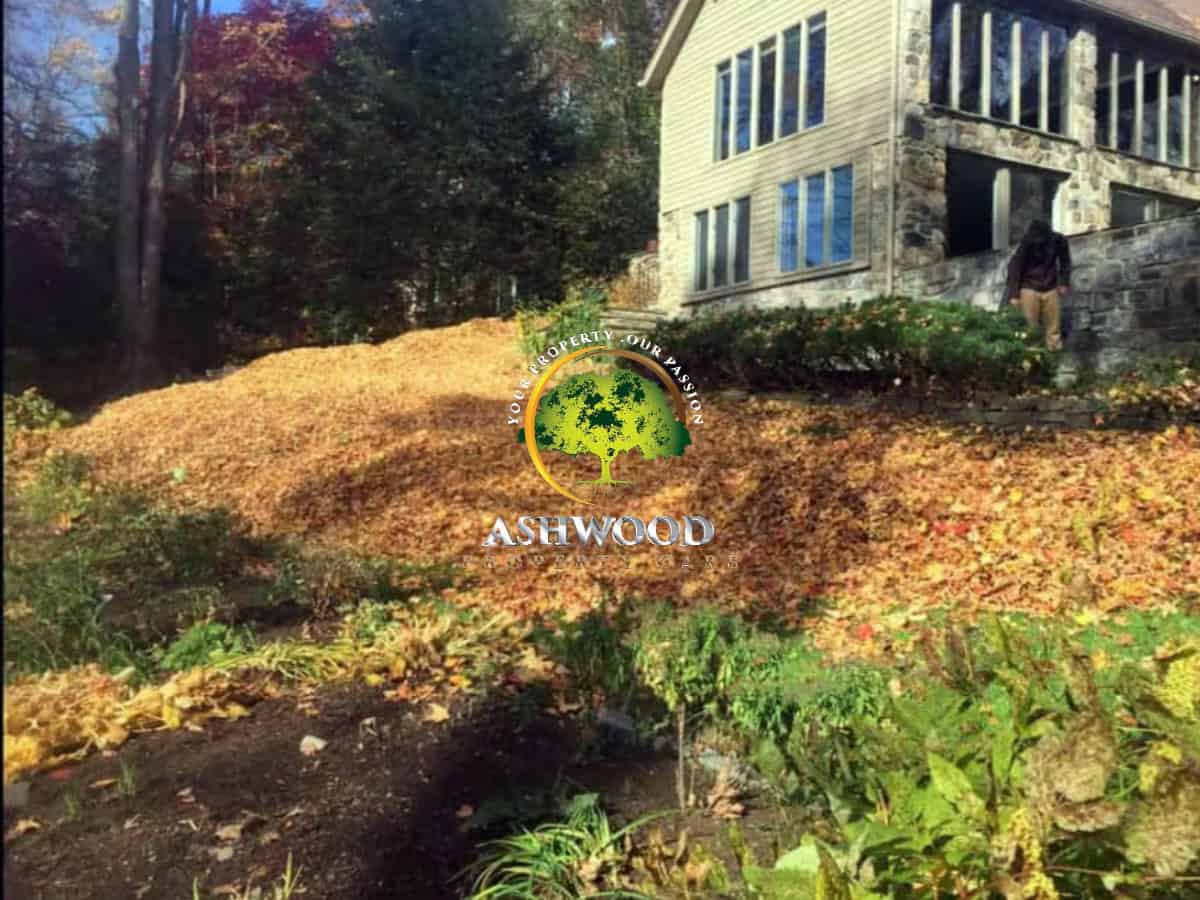
Every April I walk properties that were cleaned up the previous fall, and within five minutes you can tell how it was done.
The lawn on the north side of the house has gray, matted patches where a layer of wet leaves sat under the snow all winter. A low spot beside the front walk held meltwater for four months, and the walk has the stains and the heaved stone to show for it. The bed along the drive is a collapsed mat of last year’s peony foliage, and the new shoots are coming up through it. None of that happened in winter. It was decided the previous November, by what got done and what didn’t.
So here is the direct answer. A complete fall cleanup in western Connecticut covers six things: leaves off the lawn or mulched fine enough to disappear, beds cut back selectively rather than all at once, drainage paths and catch basins open and low spots dealt with before the ground freezes, a final mow at the right height, turf treatments done on the right calendar instead of whenever the crew happens to be there, and winter prep so the plow and the freeze-thaw don’t undo the rest. A crew that blows the leaves to the curb and drives off has handled one of the six.
I’m writing this in the first week of November. Leaves are still coming down and the ground isn’t frozen, so most of that list is still on the table. A couple of items aren’t, and I’ll be straight about which ones.
Key Takeaways
- Wet leaves matted on the lawn through winter set up snow mold. Chopped fine with a mower, the same leaves can feed the turf instead.
- Cut back what’s diseased. Leave healthy seed heads and hollow stems standing, because that’s where many native bees spend the winter.
- Most winter ice on walks and steps starts as a drainage problem: a low spot or a blocked drain sending water where it refreezes. Fall is the last chance to fix it before the ground freezes.
- UConn puts the best fall fertilizer timing in September, not November, and New York prohibits lawn fertilizer from December 1 to April 1.
- Judge a fall cleanup by what the property looks like the first week of April, not by how it looks the afternoon the crew leaves.
Why Do So Many Fall Cleanups Miss the Important Work?
It usually isn’t bad work. It’s that a fall cleanup gets sold as leaves, and leaves are the one part of the job everyone can see.
You see them on the lawn from the kitchen window. You see them in the beds. When the crew leaves and the lawn is clear, the job looks done, and for the next five months nobody can tell otherwise because it’s all under snow.
The parts that matter more don’t show. A swale outlet packed with leaves looks harmless in October. A catch basin with a grate full of leaves looks fine in a dry week. A perennial bed cut flat to the ground looks tidy, and so does one where the healthy stems were cut and the diseased foliage was left behind, which is backwards.
Timing does the rest of the damage. A cleanup scheduled before the trees are done leaves the property sitting all winter under whatever came down after the crew left.
And then there’s the spreader. When there’s a fertilizer spreader on the truck, it tends to get used. A November application can feel like the responsible thing to do. Depending on what’s in the bag and which side of the state line you’re on, it can be the wrong call or an illegal one.
Property managers see the same gaps at a larger scale. A seasonal property cleanup on a commercial site that clears the turf and skips the parking lot inlets and the swales along the lot edge has left the expensive part for the snow contractor to discover in January.
What Does the Research Say About Fall Cleanup?
Most of what follows isn’t my opinion. It’s what the extension services and turf researchers have been saying for years, and it lines up with what I find on properties every spring.
Matted leaves and snow mold
Snow mold is the gray or pinkish, crusted patching you find on lawns as the snow pulls back. Iowa State University Extension lists raking up fallen leaves, mowing at the recommended height through the fall, and avoiding excessive fall nitrogen among the main ways to keep it down.
That doesn’t mean every leaf has to be bagged. Michigan State University researchers found that maple and oak leaves could be mulched into established turf with no apparent harm to color or quality. In one set of their trials, mulched maple leaves also reduced dandelions by as much as 80 percent compared to untreated plots. The condition that matters comes from University of Minnesota Extension horticulturist Mary Meyer: keep running the mower over the leaves until you can see the grass through them. Chopped leaves break down into the soil. Whole leaves mat down and smother it.
So the real question isn’t rake or don’t rake. It’s matted or mulched.
Fertilizer timing
UConn’s Home & Garden Education Center puts the best times to fertilize Connecticut lawns in September and in late April through May, with no more than one pound of nitrogen per 1,000 square feet in a single application. Too much nitrogen, they note, makes turf more susceptible to disease. Connecticut has also limited phosphorus on established lawns since a 2013 law, which is why lawn fertilizers sold here usually show a zero in the middle number.
New York goes further. The state’s Nutrient Runoff Law prohibits applying lawn fertilizer between December 1 and April 1, and restricts application within 20 feet of a water body or on paved surfaces. Our service area includes Dutchess, Putnam, and Westchester Counties, so that date applies to every property on that side of the line.
Fall is still the most important season for turf. It’s when we core aerate and overseed, and it’s the right time to lime if a soil test calls for it. UConn notes that many Connecticut soils sit around a pH of 5, cool-season grasses want the mid-6s, and limestone takes anywhere from six to 18 months to move the number. Lime applied this fall is working for you next summer.
Low spots, blocked drains, and the front walk
Water doesn’t stop moving in winter. Every thaw sends meltwater looking for the lowest point, and on a lot of properties that’s a walk, a set of steps, or a corner of the drive. It sits or sheets across the pavement during the day and refreezes at night, in the same spot, all winter.
Most of it traces back to something you could see in the fall. A dip in the lawn next to the walk. A settled paver. A swale whose outlet is packed with leaves. A catch basin grate matted shut. Each one holds or redirects water until the temperature drops.
As I wrote in our post on what to ask before signing a snow removal contract, Connecticut’s ongoing storm doctrine doesn’t protect a property owner from ice created by a drainage problem, like a low spot in the pavement that holds water. That’s a maintenance problem, not a weather problem, and fall is when it gets solved.
Perennial beds
Extension guidance on perennials has shifted over the last decade. Penn State and University of Illinois Extension now recommend leaving many healthy perennials standing through winter, because native bees and other beneficial insects overwinter in hollow and pithy stems, and the seed heads feed birds. The plants that should come down in fall are the ones carrying disease or pests. Peony foliage and bee balm with powdery mildew are common examples.
A bed cut uniformly to the ground in October looks neat for a week. It has also removed the habitat, and very often the diseased debris got raked into the mulch on the way out.
The April Walk
Here’s the reframe I’d offer, and it’s the one thing in this article I’d ask you to take with you.
Most people judge a fall cleanup the afternoon the crew leaves. The lawn is clear, the beds are tidy, the truck is pulling out. That’s the wrong moment to judge it, because nothing the cleanup was supposed to prevent has happened yet.
Instead, picture the first warm week of April. The snow has pulled back. Now walk the property in your head, one area at a time.
What’s on the north lawn where the leaves were heaviest? What’s sitting in the low spot beside the front walk? Where did the water go during the February thaw? What’s coming up through the beds, and what is it coming up through? Is there a dead strip along the drive where the plow piled snow onto turf? Is the stone walk still flat?
Every one of those answers gets settled in October or November. If the cleanup covered it, April is a light spring cleanup and an early start on the season. If it didn’t, April is repair work, and you’re paying for it during the busiest weeks of the year.
That’s the April Walk. It takes ten minutes with your cleanup scope in hand, and it’s the most reliable way I know to tell a complete fall cleanup from one that only looked complete.
What Should a Complete Fall Yard Cleanup Cover, Line by Line?
This is the scope I’d want in writing. Not every property needs every line, but every line should be a decision somebody made on purpose.
Leaves
Lawn, beds, foundation plantings, under decks, along fences, and in the corners where the wind piles them. Light cover on turf can be mulched in with the mower if the grass shows through afterward. Heavy drop comes off. Leaves don’t get blown into the beds and left as a wet layer against the crowns of perennials and shrubs.

Beds and perennials
Diseased and pest-prone foliage cut and taken off the property, not composted on site. Healthy stems and seed heads left standing where they add winter structure or habitat, then cut in spring. Annuals pulled. Bed edges redefined so spring mulching starts clean.
Drainage
Catch basin grates, swales, French drain outlets, culverts at the end of the drive, and window wells cleared of leaves and debris. Any spot where water stood or sheeted across pavement during the fall rains gets noted, and the ones beside walks and steps go to the top of the list. Fall is the last chance to fix drainage before the ground freezes, and a lot of the drainage work we do starts with somebody finding the problem in January.

Turf
A final mow at the same height you’ve kept all season. Our standard is 2¾ inches or taller, not left long to mat under snow and not scalped short on the last pass. Aeration and overseeding done in early fall, while the soil is still warm enough to establish seed. Lime applied if a soil test calls for it. Fertilizer applied on the right calendar, which in most years means the main fall application already went down in September. Our landscaping services page covers how we approach lawn care through the rest of the year.
Winter prep
Driveway and walk edges staked so whoever is plowing can see where the turf and beds start. Irrigation shut down before a hard freeze. Loose stones in walks and steps reset before freeze-thaw moves them further. If the property has a pool, it’s closed.
How Do You Get More Out of the Fall Cleanup You’re Paying For?
- Get the scope in writing, line by line. “Fall cleanup” on an invoice can mean almost anything. Ask for the list above, or your contractor’s version of it, and see which lines are missing.
- Time the cleanup to the trees, not the calendar. Ask when the crew plans to come and what happens to the leaves that fall after they leave. A cleanup timed for convenience can miss a good part of the drop.
- Walk the beds with whoever does the cutting. Five minutes pointing at what stays and what goes is the difference between selective cutback and a bed cut flat to the ground.
- Look through every catch basin grate. If you can’t see the bottom through the leaves, neither can the water. Check the outlet end of any swale or French drain while you’re at it.
- Mark your low spots during the next rain. Walk out with an umbrella, note where water sits or sheets across a walk, and put those spots on the list while the ground can still be worked.
- Check the timing on any fertilizer. If someone wants to fertilize your lawn in late November, ask what’s in it and why now. On a New York property after November 30, the answer is no.
- Put the April Walk on your calendar. Set a reminder for the first warm week of April and walk the property with this list. Whatever you find is next fall’s scope.
Frequently Asked Questions
When should a fall cleanup be done in western Connecticut?
Late enough that most of the leaves are down, and early enough to finish before the ground freezes and snow falls on whatever is still lying on the lawn. The right date depends on the trees on your property and the year’s weather, so time it to the leaf drop, not the calendar.
Is it better to rake leaves or mulch them into the lawn?
Either works if the end result is grass you can see. Michigan State research found that leaves mulched into established turf caused no apparent harm and reduced dandelions. Light cover can be mowed in. Heavy drop that won’t chop fine enough should be removed so it doesn’t mat down over winter.
Should perennials be cut back in the fall?
Not all of them. Diseased or pest-prone foliage, such as peonies or bee balm with powdery mildew, should be cut and removed in fall. Many healthy perennials can stay standing until spring, where their hollow stems shelter overwintering native bees and their seed heads feed birds through the winter.
Why does the same spot on my walk ice up every winter?
Usually it’s water, not weather. A low spot beside the walk, a blocked swale or catch basin, or a snow pile melting uphill sends water onto the pavement during the day, and it refreezes at night. Fixing the grade or clearing the drain in fall solves it before the ground freezes.
Is it too late to fertilize or overseed in November?
For overseeding, usually yes. Seed needs warm soil and fall rains to establish, which is why late summer and early fall are the recommended window. UConn puts the best fall fertilizer timing in September. On New York properties, lawn fertilizer is prohibited by state law from December 1 through April 1.
Before the Ground Freezes
Every fall cleanup ends the same way from the street. The lawn is clear, the beds are neat, the truck pulls out. The difference between a complete one and an incomplete one doesn’t show up for five months.
It shows up the first warm week of April, when you walk down the drive and look at the north lawn, the low spot by the walk, the edge of the bed, the stone walk. Either the property comes out of winter ready for the season, or it comes out with a repair list.
If there’s still time on your property this year, use it. Leaves are still coming down and the ground isn’t frozen. Clear the catch basins and swale outlets after the last of the drop. Cut what’s diseased and leave what’s healthy. If fertilizer is going down, ask what’s in it and why now.
And if this season’s cleanup has already happened, take the list above, set a reminder for April, and do the walk. Whatever you find is next fall’s scope.
A fall cleanup isn’t the last visit of the season. It’s the first visit of the next one.
Keep Learning
- Landscaping Services — Lawn care, fall aeration and overseeding, seasonal cleanups, and ongoing maintenance.
- What Should You Ask Before Signing a Snow Removal Contract in Western CT? — Six questions to settle before the first storm, including why drainage ice isn’t covered by the ongoing storm doctrine.
- Drainage Solutions Gallery — Fall drainage work that keeps water off walks and drives.
- Snow & Ice Removal Services — How our winter service picks up where the fall cleanup leaves off.
- Turf Care Gallery — Lawns we maintain across western Connecticut.